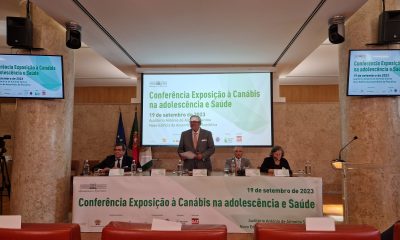
“Domestic Cannabis Cultivation: between the Autonomy of Pleasures and Criminal Embarrassment” will be up for debate tomorrow, April 26th, at 16pm, at the 23rd Conference organized by the Center for Interdisciplinary Research on Crime, Justice and Security (CJS) of the School of Criminology of the Faculty of Law of the University of Porto (FDUP). At the event, which takes place at FDUP Amphitheater 128 and can also be watched via Zoom (link at the end of the article), the results of the first questionnaire to cannabis growers in Portugal will be presented.
To discuss the matter, Professor Rita Faria, PhD in Criminology, Master in Sociology, Graduated in Law and currently Assistant Professor at the School of Criminology at FDUP and Director of CJS, and Professor Jorge Quintas, Director of the Master's Degree in Criminology at FDUP will be present. , author of several books and specialist in subjects related to drug use, cultivation and policies in Portugal. Researchers conducted an anonymous survey in Portugal The conversation will be moderated by CJS researcher Ximene Rego.
Jorge Quintas completed his PhD in Criminology in 2007 at the Faculty of Law of the University of Porto. He is Assistant Professor and Director of the Masters in Criminology at FDUP, having held the position of Director of the School of Criminology at FDUP, from 2017 to 2021. He has published about three dozen articles in specialized journals, most of which are international and are the result of participation in scientific projects with colleagues from different countries. He has also published five books (some co-authored), several book chapters and multiple specialized technical reports. He specializes in matters related to the use and cultivation of drugs, as well as drug policies in Portugal and other countries.
Rita Faria has a PhD in Criminology, a Master's in Sociology and a Degree in Law. She is currently an Assistant Professor at the FDUP School of Criminology and Director of the CJS. She has been actively researching and publishing on topics such as environmental crime and Green Criminology, as well as white-collar crime, financial crime, organizational crime, and occupational crime, including deviant behavior in scientific research. She is President of the European Working Group on Organizational Crime (EUROC) and a board member of the Working-Group on Qualitative Research Methodologies and Epistemologies (WG-QRME), both of the European Society of Criminology. She is the editor of “Criminology in Europe”, the newsletter of the European Society of Criminology and member of the board of this Society. In 2023, she was distinguished by the Centro Ciência Viva, as one of the 101 Portuguese female scientists.
The debate “Domestic Cannabis Cultivation: between the Autonomy of Pleasures and Criminal Embarrassment” takes place tomorrow, April 26th, at 16pm, at FDUP Amphitheater 128 or via ZOOM at the link: https://videoconf-colibri.zoom. us/j/96696416349
Results of the questionnaire started in 2012 will be presented and discussed
The Global Cannabis Cultivation Research Consortium (GCCRC), which brought together researchers from around the world, including Prof. Jorge Quintas, tried to better understand the domestic cultivation of cannabis to combat stereotyped views about those who grow it on a small scale, whether for recreational or medicinal purposes.
With the incorporation of Portuguese researchers from the School of Criminology of the University of Porto and the University of Ghent, it was possible to integrate Portugal into this consortium and to participate in the ICCQ 2.0, the second version of the International Questionnaire on Cannabis Cultivation, which began in 2012. year after the survey was published, some of the main results relating to Portuguese participation were published.
The study involved 116 Portuguese growers (about 1% of the world total) who identify themselves, mostly, as being male (87,6%). They have an average age of 33 years, are generally employed, have different levels of education and come mainly from urban areas. Participants maintain a stable cultivation activity (75% have cultivated cannabis in the last year; all have cultivated in the last 5 years) and are regular consumers (69% consumed on the same day; 89% in the last week).
The cannabis consumed is mostly from the cultivation itself (on average, 62%). Participants typically grow several strains of cannabis by themselves, mostly obtained through online stores, in living organic soil, using organic fertilizers, supplements or insecticides and indoors. The main reasons for cannabis cultivation reported by 60% to 80% of participants are: the pleasure of growing cannabis; obtain cannabis for recreational use; because the cannabis you can grow is healthier than what you can buy; to avoid contacts with criminals; for being cheaper; because they consider the plant to be beautiful and because the cannabis obtained in this way will not contain adulterants.
The results also revealed that the average age at the time of the first cultivation is around 25 years, and that, on average, they cultivate for 8 years, having carried out about 10 plantations throughout their lives and two in the last year (all these average values tend to be lower than those found in most of the participating countries).
As the cultivation of small amounts of cannabis is (still) criminally punishable in Portugal, the knowledge of growers about the legal status of this activity is very diverse. Around 60% of the participants consider that the cultivation of cannabis for recreational purposes is illegal and that it is actively pursued by the police. Already 24% consider that such acts, being illegal, do not deserve the attention of the police and the rest consider it legal to cultivate cannabis in Portugal. With regard to cultivation for medicinal purposes, about half consider cultivation illegal and about a third believe that such acts are actively investigated by the police. In general, many growers, therefore, have an optimistic perspective of non-legal intervention in cultivation, either because they consider that there is no legal provision (which, it should be noted, exists in the form of a crime), or because of the perception that there is no intervention police in such acts.
Growers also showed a wide range of positions regarding their estimation of the risk of being detected by the police for growing cannabis. However, from the responses collected, no respondent was stopped by the police for growing cannabis. Other infractions of the law besides the actual cultivation of cannabis are also very rare.
The pandemic has not affected consumption or the cultivation pattern of most cannabis growers. However, around 20% of those surveyed have actually started to cultivate since the COVID-19 pandemic took hold, and more are those who have increased cultivation than those who have reduced it.
Thanks. Our survey is now closed.




 Listen to this article